_edited.png)
1.5
The Role of Values in Collaborative Discussion
Submitted by Jack Byrd Jr.
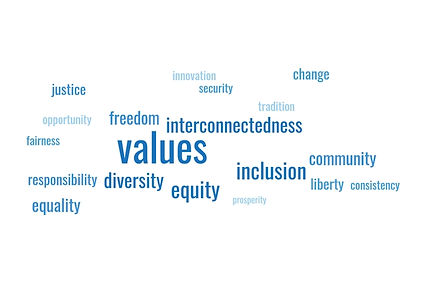
This activity encourages participants to reflect upon and identify their personal values and to explore the role that values play in group discussions.
Learning Goals
Identify different kinds of values that are commonly embedded in a discussion.
Better understand how personal values can inform contributions in discussions.
Instructions
Set Up: Prepare for the Activity
Organize participants into small groups (5-6 ppl).
Begin by introducing the learning goals of this activity.
Step One: Craft Three Individual Value Statements (10 min)
Offer a few minutes for each participant to quietly craft their own value statements.
Share the following prompts:
What values are most important to you as a person? For example, maybe it is self-sufficiency, environmental sustainability, or justice. Write down your top values.
Take your top three values and craft value statements. For example, “I value personal responsibility. I believe that I, alone, am responsible for my actions.”
Step Two: Share Value Statements (10 min)
Within small groups, ask participants to share their value statements with at least one other person. Discussion partners can ask questions about value statements but they should not make comments or share judgments. For example, discussion partners might ask:
Where does this value come from? Was it taught to you or did you learn it some other way?
Can you share with me a time when you acted on this value?
Step Three: Practice Listening for Values in Discussions (30 min)
Craft a discussion prompt that is relevant for your group, or select one from the list of What IF… Scenarios.
In small groups, encourage participants to engage in honest discussion for about ten minutes. Allow enough time for everyone in the group to respond to the prompt.
Ask each group to pause the discussion and take a step back. Instruct participants to not worry about who was most convincing. Instead, as a group, ask them to identify which values informed their opinions. Prompts:
Which values informed the perspectives of people in your group?
How might someone else, not present in your group, respond to the prompt? What values would be informing their opinion?
Step Four: Debrief as a Full Group (10 min)
Discuss:
How does shifting the focus on values change the way you engage with others in discussion?
Which values seem most common and which seem to be outliers or less common? What does this tell us about our group?


TIME
60
min
MODULE
Introduction to Collaborative Discussion

This activity can be completed by any discussion group.

This activity can be used to build trust and interpersonal connection.

This activity can be used to support facilitation skills. See Sample Facilitation Certificate Program Design to illustrate sample sequencing.

This activity is suitable for professional or more formal learning environments.
Tell us what you think. Rate and review this activity:
Have any helpful suggestions or modifications for this activity?
Share them in the comments below!
0 Comments
Sovi Herring
June 26, 2023 at 4:55:50 PM
I did this as a sub for a class and it went really well! The only feedback I have is that the prompts are a little long. I didn't edit them for this class, but I did offer a second prompt. Other than the bulky-ness, it was a great conversation and activity to have students do. Here are the materials I used in a Google folder: https://drive.google.com/drive/folders/1QOVDnMYkouMsXtM9DfSVO38adPXdqKyM?usp=sharing
June 23, 2023 at 1:57:47 PM
June 22, 2023 at 11:02:10 PM
June 21, 2023 at 11:24:58 PM
June 16, 2023 at 11:56:28 AM
Fun activity!
June 16, 2023 at 1:01:38 AM
Great activity!
June 16, 2023 at 1:00:51 AM
anon
May 25, 2023 at 9:27:08 AM
Great site!
May 22, 2023 at 3:54:26 PM
RT
January 16, 2023 at 7:39:09 PM
This activity could possibly pair with Activity 1.8, which evaluates current discussion style. After completing that evaluation, this activity could be used to help participants envision and set goals or intentions for how they would like to participate in discussions going forward.